Some questions are easier to answer than others.
When I ask my 4 year old the color of an object, or its shape, I get concrete answers back...and quickly...sometimes too quickly!
However, when it comes to deeper things, the answers aren’t always so clear, and that’s why we’re posing the issue above as a question.
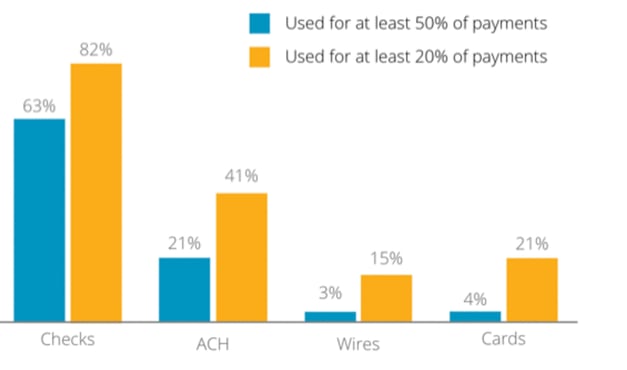
Here’s a look at the facts about payment methodologies for Accounts Payable departments in the US courtesy of Paystream Advisors
http://www.paystreamadvisors.com/effortless-transition-manual-electronic-payments/
What’s obvious from this chart is that most American businesses are still heavily reliant on check cutting to make payments. Considering that many businesses are looking to enhance their productivity and profitability it’s kind of ironic that they are dependent on antiquated and costly ways of doing things, and in this case, paying the bills.
When you couple the fact that cutting a check has an average cost of $5.14 per check according to The Accounts Payable Network, and that wires can exceed $15 per transaction, you can start to grasp the magnitude of what you are literally sending out the door. To do a quick analysis, just look at your non-payroll related checks that went out last year and multiply times those figures depending on your spread of payment types and you’ll have a healthy approximation for the total process costs you’re looking at.
So, how to evaluate whether virtual payments are a good option for you?
- Will my vendors accept? - Well some make this evidently clear on their invoices in the remit or payment instructions areas. For those, the task is easy to figure out. For others, it may require a more assertive campaign of vendor onboarding, which can be an arduous process for the company deploying the virtual payment inititative. However, certain virtual payment providers actually act on behalf of your organization for the vendor enrollment and as such, can considerably offset the time investment required to advance it.
- Is it worth it? - Again, you’ll need to some quantitative and qualitative analysis on how your current payment metrics look. If the bulk is via check or wire, then you have some basic math to do to determine your extraneous costs. Beyond that, ask yourself what your payments are earning you. If it’s either of the two mentioned here, that would be zero, zip, nada. However the virtual MasterCard option could be anywhere from 1-1.5%. Multiply that range by about a third of your payables spend (to allow for a conservative estimate of those who would accept the virtual payment) and you’ll have an idea of the annual contribution to your business. Secondarily, multiply the correlating number of checks that you would normally produce for that spend times $5.14 or $15 for the wires and you’ll know what hard costs are going to be recouped….then ask yourself is it worth it?
- Is security an issue? - That’s definitely a worthy question. Security is an issue for some AP departments, but the virtual MasterCard is more secure than checks and individual corporate card accounts that are used to pay multiple vendors. Why? For starters, they are single-use, and a unique 15 or 16 digit card account is created per payment. A payment may encompass multiple invoices, but the point is it can be reused. Secondly, the amount paid is funded specifically for the payment amount invoked, and can’t be expanded. Therefore, it can’t be run through multiple times or for increasing amounts and is therefore a better alternative than using one traditional card to pay multiple accounts.
So, there are certainly some compelling elements to making the case for virtual MasterCard, but probably none more-so than profitability. If you’re looking for a way to make your accounts payable process strategically valuable and profitable, then this is a key thing to consider!



.jpeg?width=30&name=fcf4d58868b0736dbe23294dd017d32c%20(1).jpeg) Chris Cosgrove: May 8, 2026, 11:00:12 AM
Chris Cosgrove: May 8, 2026, 11:00:12 AM